
Grafting the European Experience on the Middle East and North Africa
top of page
About
Principles
History
Internships and Fellowships
Contact
Frank Fund Scholarship -
Stay Informed
Programs
Democracy and World Organization
The Federal Paradigm
Existential Risks and Planetary Policy
The Extended Transatlantic System
Publications
Blog Posts and Commentary
Books by Board Members
Publications by Affiliated Members
People
The Team
Board of Directors
Advisory Board
Alumni
Donate
Grafting the European Experience on the Middle East and North Africa
May 31, 2011
2 min read
Updated: May 31, 2020
By Mitch Yoshida, Mayme and Herb Frank Research Fellow
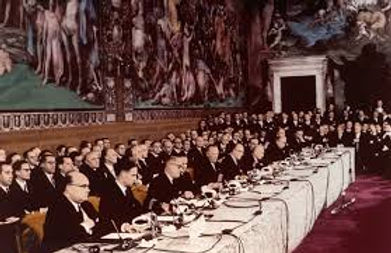
The Signing of the Treaty of Rome
Although U.S. Secretary of State Hillary Clinton and Treasury Secretary Timothy Geithner’s recent call for freer trade among nascent democracies in the Middle East and North Africa (MENA) is a constructive recommendation, they put the cart before the horse by drawing a historical parallel to post-Cold War Europe. In a joint letter to their G-8 counterparts on May 25th, they argued:
“Just as membership in the European Union served as a powerful incentive for economic transformation in Central and Eastern Europe after the Cold War, so should the prospect of participating in an integrated and dynamic regional economy create a powerful force for reform in the Middle East and North Africa.”
Fair enough, but an integrated trade area must first be created before it can attract new members. Hence, the situation in MENA is currently closer to that of Western Europe during the 1950s and 1960s, when that region’s leaders took their first steps toward liberalizing trade and creating the Common Market. But historical analogies are never perfect, and this is no exception. In Western Europe, the desire to avoid another conflict and Cold War pressures were key forces that drove leaders to open regional trade. French and German leaders, who were central to the project, largely viewed it as a way to reduce the likelihood of war between their states and strengthen Europe vis-à-vis the Soviet Union.
Egypt and Tunisia, in contrast, do not face similar pressures and have not even elected new leaders. In the absence of existential threats, it will be vitally important to ensure that potential leaders and electorates in these countries understand that freeing regional trade is one step they can take to ensure their prosperity. They may be receptive to the suggestion as majorities in both countries believe their respective economies are in dire straits, but it is unclear that such support already exists or will be easy to secure.
US Foreign Policy
International Order
World Organization